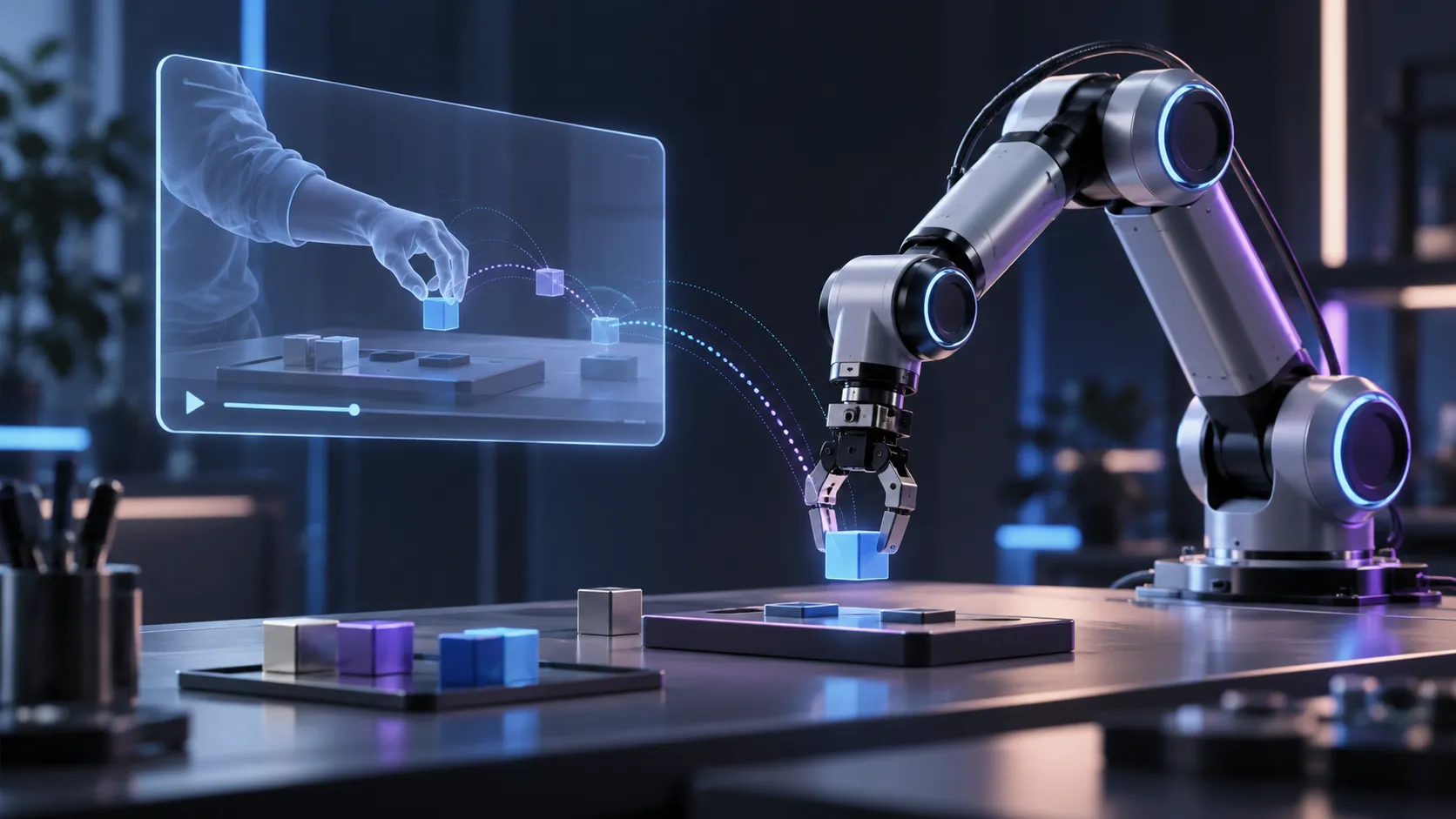
Physical AI: What Robots Learning from Video Really Changes
Skild AI's recent S1 announcement highlights learning from video demonstrations. The engineering challenge is making that flexibility dependable.
Physical AI is bringing renewed attention to how robots acquire new skills. In a September 10, 2026 report, NVIDIA described Skild AI's S1 model as learning unfamiliar tasks from a video demonstration without task-specific weight updates. The report also describes simulation and training infrastructure used in its development. These are company-reported capabilities, rather than an independent guarantee for every deployment. Read NVIDIA's report.
The interesting engineering question is what easier demonstration changes about building and operating an automated workflow. The analysis below looks at that question from a software developer's perspective.
A demonstration becomes another input
Imagine a warehouse station that assembles a small kit. A human demonstration can show the intended sequence: select an item, place it in a tray, add another item, and move the completed kit.
That is a hypothetical example, not a claim about a particular deployed product. It illustrates a useful shift in interface design: part of the task description can be visual instead of a manually specified motion sequence.
But the demonstration leaves questions unanswered. What if the second item is missing? What counts as correctly placed? When should the robot stop and ask for help? A production workflow still needs explicit acceptance criteria.
Measure completed tasks
An impressive clip provides limited evidence about repeated operation. Ask how many complete tasks were attempted, how many finished without intervention, and what conditions were included.
A simple mathematical example shows why the unit of measurement matters. If a hypothetical ten-step process succeeds independently at each step with probability 95%, its chance of completing all ten steps without a failure is about 60%. Real failures may be correlated, so this calculation is only an illustration, not a model of S1.
The practical lesson is to request end-to-end results. A per-step score and a finished-job success rate answer different questions.
Make recovery part of the workflow
A useful pilot should include a moved object, an empty bin, and a blocked destination. Record whether the system detects the problem, recovers appropriately, or asks for assistance.
The surrounding software matters here. Operators need a visible task state, understandable failure messages, and a way to resume without accidentally repeating a completed action.
Application developers already encounter similar problems when a network request times out after a server has saved a record. The physical setting changes the consequences, but uncertain state still requires careful reconciliation.
Evaluate the cost of supervision
A robot that completes a task slowly but needs little attention may be useful in a different setting from one that moves quickly but needs frequent resets. Compare intervention time, setup effort, and completed work under representative conditions.
Start with one bounded workflow and document its operating limits. Expand only after testing the variations that occur in the actual environment.
For developers entering this area, useful contributions extend beyond model training: operator interfaces, event histories, evaluation tools, and integration with existing systems all need careful engineering. The discipline of separating responsibilities, explored in this architecture guide, remains valuable when software begins directing physical work.